Friday, March 18, 2011
fools that will laugh on earth must weep in hell: doctor faustus
Posted by Corinne at 12:55 AM 1 comments
Labels: the arts
Friday, March 11, 2011
king lear
***
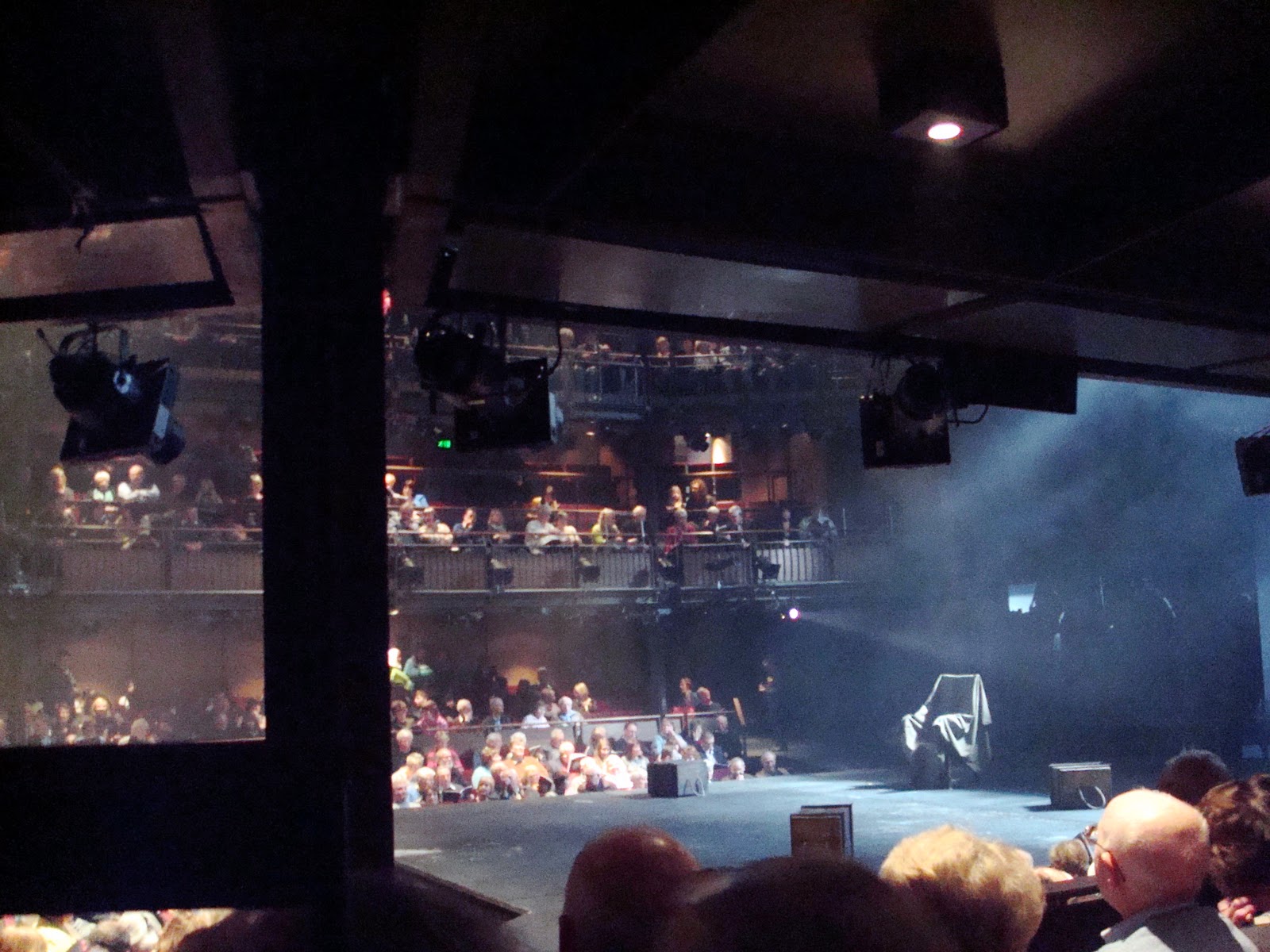
In last night's Royal Shakespeare Company's production of King Lear, for which we travelled by train to Stratford-upon-Avon, this haunting scene left us shivering alongside Lear at intermission. The show itself was gorgeous, with only a few negatives (the second half, perhaps too indulgent of Lear's crazy-speeches, dragged; Cordelia was only so-so) to mar our enjoyment.
We also got to look around Stratford itself for awhile. It's a cute little town on the river whose only claim to interest, of course, is good old Bill, whose home (pictured above) we visited excitedly. Consequently, every cafe and pub and shopping-centre and street name seems to have some relation to the Bard--and some of them are quite silly.
Along the river, we stopped to muse at the statue of the man himself: he sits atop a high throne, and sculptural renderings of Prince Hal, Falstaff, Lady Macbeth, and Hamlet surround him in death as they did in life.
In fact, I even got a little up-close-and-personal with Falstaff. My eyes are up here, buddy.
All in all, Robby and Kelly and Megan and I--three of us in the English M.St programme, and one amateur enthusiast--had a lovely time in Stratford, and the show definitely lived up to its expectations. Hicks' Lear is not one to miss: students in and around Oxford, do yourself a favour and pick up a £5 ticket for this spectacular performance.
Posted by Corinne at 6:20 PM 2 comments
Labels: the arts, touristy fun, UK chums
Sunday, February 27, 2011
spring awakening
On Wednesday, I travelled with the old gang to see Brian in Spring Awakening, in which he played Melchior. My primary reaction to the play is to exclaim, fangirl-like, about how fantastic Brian was: he was amazing! I hope that all of you in Oxford got a chance to go see the production, though its tragically short run meant that it sold out quite quickly. We even got to snap a photo with the gorgeous and talented Brian, at which point Mark was apparently so taken by Brian's unparalleled glories that he couldn't look at the camera:
But that doesn't make for a very good blog post, particularly when there's a play review just a couple of posts down from here. My real reflections on the show stem from problems that, by now, are largely out of the control of a particular cast or crew; the broader issues that I have with the play itself are still settling, and I think I'd rather write about them than Lewis Carroll for awhile, so I will.
The show--as many of you probably know--centres around a small German village around the turn of the century, in which the youth are undergoing something of a sexual and ideological revolution. One young man, Melchior (played, of course, by the above-mentioned (and -pictured) Brian) stands diametrically opposed to the generation of adults in this particular community: Melchior is an atheist, Melchior is sexually aware, Melchior is open to talking about his experiences and ideas. He quickly becomes, in a schoolroom scene somehow strangely reminiscent of Dead Poets' Society, the voice of awakening: the voice of, "it's okay to think about sex; it's natural!" to a group of boys who are tragically repressed. He has particular effect on one boy by the name of Moritz who comes to regard Melchior as a mentor in sex and faith and life. Melchior's enthusiastic commitment to a frank and candid education does not find its limit in his classmates, and Melchior, in the first act's climax (yes, okay, pun intended), has sex with Wendla, a beautiful young woman in the same community. I won't ruin it for you, but Moritz and Wendla both suffer deeply for their awakening, for their association with Melchior, and we are left to wonder: was it worth it? Could Melchior be no better for these people than the blind, ignorant faith against which he so vehemently rebels?
In that famous culminating scene of the first act--famous not least because its original staging involved a naked Lea Michele--Melchior and Wendla have a sexual encounter of a dubious nature: was it rape? Certainly Wendla says "no" more than once, though she appears to yield willingly in the end. However, this circumstance occurs not without some significant pressure on the part of Melchior, who clearly understands the implications of their actions far better than Wendla herself does. This particular production seemed to favour the interpretation that, though Melchior did act a bit pushy, the decision to have sex ultimately rested equally with both of them: that Wendla wanted it, rationally as well as emotionally. However, a different production could easily have reinterpreted Wendla's initial refusal and ultimate submission, particularly in light of prior scenes (one in which Melchior characterises the role of the woman as a submissive one; another where Wendla asks Melchior to beat her so that she can understand how it feels and Melchior, getting entirely too carried away, hurts and scares her). In the end, I wish that the production had dealt more with the implications of the complicated situation that is rape.
The play did deal with a number of issues--too many, perhaps. Sometimes one scene (or, more frustratingly, one musical number) would address an issue to which the play would never, or only slightly, return. These issues include incest, homosexuality, and physical abuse: all issues that are brought up but not explored, to the detriment of the show as a whole. The musical numbers, then, sometimes feel unrelated; I didn't get that sense that the musical elements of the show were a necessary outpouring of the non-musical elements, and that is a sense that I get with musicals like Les Miserables, Phantom of the Opera, or even Wicked. The irrelevance of some of the songs was palpable: I found myself wanting, even in the midst of a lovely and well-choreographed number, to get back to the actual narrative. This is highly unlike me: during a musical, I usually live for the songs, with the narrative in between forming a sort of glue to hold numbers together. My opposite reaction to Spring Awakening may be a testament to the excellent acting--in fact, almost certainly--but it is just as much a criticism of the failure of the numbers themselves to relate, either thematically or in terms of plot.
I also wish that the script focused more on feminine sexuality. I am glad for its focus on sexuality in general: while I don't think that the show was as ground-breaking and edgy as I'd expected it to be, it did treat issues of emergent sexuality with understanding and tenderness. Male sexuality, that is: the young women in the play did little more than titter at what a cutie-pie Melchior was. Only Wendla expresses any mature desire, and this maturity is marred by the fact that she is possibly raped in her only sexual encounter; either way, after the encounter she becomes clingy and lovestruck, idealising about a future with Melchior and their yet-unborn child--in other words, she acts like a total girl about it all, from the initial resistance to the eventual yielding to the resultant emotional dependence. All of that is fine and not unrealistic, but what I would have liked from the playwright is a more frank portrayal of female sexuality and desire.
All in all, I think the play should have made fewer concrete decisions. This particular production seems to have decided certain things: Wendla wasn't raped, at least not really. Melchior isn't to blame--he is merely unlucky. The conservative adults of the village behave not just incorrectly, but inexcusably so. Ultimately, I wish that the show itself, whether this is a flaw with the script or with this production in particular, left a little more work to the audience at the end. I want to leave a show with the sense that my interpretation is either flawed or imperfect, or at least that my interpretation wasn't handed to me on a plate.
Incidentally, my lovely friend Karith wrote a blog post on the same production; I have intentionally refrained thus far from a thorough reading of her interpretation because I have reason to believe that it will be not dissimilar from my own. So I don't know about you, but I'm off to read her take on things.
Three blog posts in less than a week? I'm on fire, y'all.
Posted by Corinne at 12:08 AM 0 comments
Labels: the arts
Wednesday, February 23, 2011
marbling
Legitimately, I won't be offended if six of you comment to say, Corinne, stop writing about your boring printing class! For one thing, it would mean that six people had read my blog post; it would also be the most comments I'd ever gotten. In addition, I know in my head that this can't possibly be as interesting to everyone else as it is to me. But this is so cool and I therefore want you to hear about it anyway.
So when we last left our printing heroine, she had set, proofed, and printed bunches of copies of her poem, alongside the poems chosen by everyone else. The time has come to finish it all up: to make an actual book. A pretty book, with pretty paper on the outside. Fortunately, this is actually quite easy: step one involves a simple bath of water and some oil paints. Here (above left) I've squirted some blue and some gold into a water bath. The oil floats on the top.
Then all that's left is to (gingerly!) pull it out and hang it up with clothespins on the line to dry. This is one of my first attempts, though it's serviceably good as a cover page. The paper will have soaked up most, if not all, of the oil paint in the water, so there's generally no cleanup to do before squirting more paint and going crazy with another piece of paper. Once we got the hang of it, we started using straws and combs and pointy things to move the oil around, and we can blow on it before putting a paper in for a different effect.
Here, some of our creations hang to dry. The blue and purple one on the right is one of mine; it's also the first in which we used our spanky new purple colour. Below, some mostly-dry beauties (this must be late in the day--these are rather good) chill out on the cases of type.
Next week: binding! Same bat-time, same bat-place. THIS IS THE COOLEST CLASS EVER.
Posted by Corinne at 9:35 AM 2 comments
Tuesday, February 22, 2011
a dream play
Okay, okay. I haven't posted in ages. But it's February, and most of you know how I feel about February; I can be excused, right? Anyway, I went two days ago (with a lovely ragtag group of random friends) to see an adaptation of August Strindberg's A Dream Play that was put on at the Oxford Playhouse, and it's been rattling around in my head ever since.
Posted by Corinne at 6:43 PM 3 comments
Labels: the arts