Sunday, March 20, 2011

spring!

In an unbelievably unfair (given the current Red Alert status on the stuff-I-have-to-do meter) move on the part of Oxford, the weather has been gorgeous lately: sunny, blue-skied, relatively warm. So warm, in fact, that sitting in the park at Wellington Square (a park that has been featured on this blog before, as here and here) making a flower-chain crown for my hair and laying in the grass is quite a feasible alternative to, say, doing all of the paper writing and editing I have to do.

Actually, spring in Oxford came to me quite suddenly. In the midst of long library days, it's easy to ignore the ten minutes to and from the Bodleian that I usually spend head down, earphones in, powering through the usual wind and cold. All of a sudden, I turn a corner in a passage that I walk every day--and I almost run into a gigantic white cherry-blossom tree. It is cloud-like, voluminous--and has blossomed, apparently, overnight.

And that's when warmth and sunlight occurred to me, too. Either the elements conspired to become spring all at the same moment (possibly with the sole purpose of confusing me), or I've been walking around for two weeks unaware of my surroundings.

At any rate, it's brilliant. Come Thursday, I'll be free, for a little while anyway, and that freedom may well take the form of laying in the grass.

Saturday, March 19, 2011

things to do today


Attend a fabulous (and relatively early-morning) lecture given by my lovely friend Christopher on Meister Eckhart. Fail to understand much of it. Feel, therefore, simultaneously good and bad about self.


Eat a delicious sandwich with Rowena, despite it being ten in the morning and not, therefore, optimum sandwich time.


Brainstorm reasons not to go to the Bodleian.


Go to the Bodleian despite brain's best objections.


Enjoy a brief and humorous three act play written by my dear (and absolutely insane) friend Emily. Try not to giggle too loudly; disregard own lack of success at this last goal.


Nearly perish at the sadistic whim of a hell bent, Bodleian-dwelling bumblebee.


Scrutinize every movement of said bumblebee for the next thirty minutes, just in case it's picked up my scent. 


Write blog post. (edited to reflect subsequent success)

Edit my Alice essay.

Friday, March 18, 2011

fools that will laugh on earth must weep in hell: doctor faustus

What better setting for Faustus’ hellish downfall than surrounded by books?

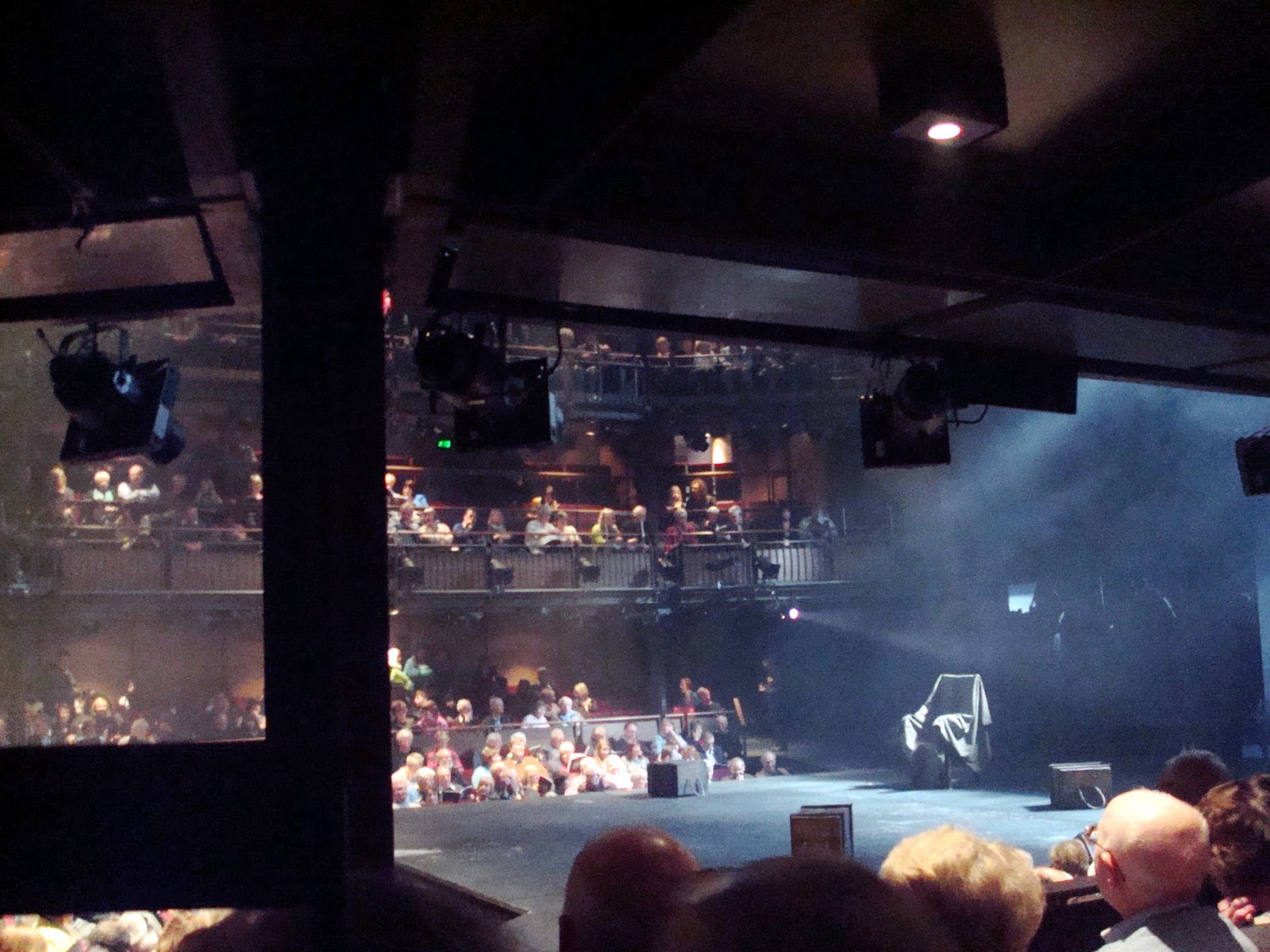
I couldn’t help thinking that to myself as I stood in Blackwell bookshop’s Norrington room, waiting for the show to start. Books of all varieties—kids’ books, textbooks, mass-market books—line the walls from floor to second-story ceiling. In the middle sits the stage: unassuming wood & cloth, nothing special.

Creation Theatre’s Doctor Faustus opens with books. Five pairs of hands around the stage, from underneath, slam down books and open them, leafing through the yellowing pages as the ensemble cast crawls onstage. A rhythmic, beatless sort of tribal dance ensues, the all-male cast treating the books themselves as idols to be revered. The play starts: the lead actor recites Faustus’ famed bored-with-everything speech while the rest of the cast sits, unassuming, browsing through the books that have now been left onstage. When Faustus quoted his Latin—from Logic, from Medicine, from Law, from Divinity—the silent readers would suddenly look up, fire in their eyes, and intone the Latin along with him. In identical exasperation, all five men would close their books with a loud slap and toss them to the side, starting on a new book together. The whole thing had an eerie, otherworldly feel: the audience was left unsure whether Faustus was moving the other members of the cast, or maybe they were moving him, or maybe some unseen force was moving them all. 

The scene where Lucifer presents Faustus with the seven deadly sins carried the same sense; part of me wanted to laugh at the foolishness of five grown men, three of whom wearing pantyhose on their heads, leaping about the stage. Part of me wanted to cry: the elaborate choreography really emphasised Faustus’ utter helplessness. Part of me felt the same acrid terror of Faustus. Still another part of me recognised in the strangeness of the scene my own distance from it, at which point their dance becomes just a dance. All the while, melody-less music beats cruelly in the background while Lucifer laughs.

The setting was simple but effective: the staging made excellent use of its trapdoors and one clever prop box. More than once I audibly yelped in fright at someone popping out of nowhere. The lighting, too, was straightforward but impeccable. Nearly every scene depended at some point or another upon a perfect light-cue being executed at the exact moment Mephistophilis stretches his hand out, and the hard-working lights operator must have put in some extra hours perfecting all of those prompts, since each was flawless.

Gus Gallagher made a brilliant Faustus: swaggeringly arrogant, even close to the end, but still somehow hollow—haunted. Gwynfor Jones, besides having a really cool name, was a stiff-armed, white-faced Mephistophilis; clad in an all-black suit, Jones’ portrayal of the somehow-sympathetic demon is characterised by sheer distance: distance from God. Distance from men. Distance from love, from humanity, from the audience.

To return to my original point, how flippin’ cool of a location is Blackwell’s? Especially in Oxford (Blackwell, for the uninitiated, is an Oxford bookshop, but they now have lots of locations across the UK), in Blackwell’s books are immaculately shiny, clean—almost, well, sacred. To watch Faustus kicking books, throwing them, ripping them apart felt like he’d committed sacrilege long before his pact with Lucifer. We live for books in this city: we base our lives around where we can find the books that we need. We complain about books and rejoice in books and have stacks of books on our desks up in the library at any given time. At some point, we have to look beyond the books into the real questions of the world, and then we have some options. A Faustus who had shunned his endless pursuit of knowledge in favour of God’s grace, for example, would have been saved and, as the good angel acknowledges, would have been filled with joy. Instead, we see a Faustus turned the other way: a Faustus who became disillusioned with his knowledgeable life and, swollen with pride, decided he could do better.

I will end as he did:

My God, my God! Look not so fierce on me!
Adders and serpents, let me breathe a while!
Ugly hell, gape not! Come not, Lucifer!
I’ll burn my books—Ah! Mephistophilis!

Thursday, March 17, 2011

i wrote a poem in the library. it is not a good poem, but it is better than working.

Kindle Therein Any Fire or Flame**

Did any of them die for burning scrolls?
Did they refuse to leave their manuscripts?
Poets’ words upon their fading lips,
did the now-nameless Alexandrian souls—
in all their million beat-papyrus rolls—
know medicine? or math? or sun’s eclipse?
Did knowledge, useless, fall in charréd strips?
Did ancient people mourn the glowing coals?
My back hurts. Bodley’s floor-to-ceiling lines
like prison bars remind me of my wrongs.
I tap my keys so not to feel alone.
Hard-covers, gleaming gilt upon their spines
edge the angles. Here, the ancient songs
cannot be heard through plaster, paper, stone.


**the title is a reference to The Bodleian Declaration, which is pasted above every desk in the Bod. Among its many provisions includes, "I hereby undertake . . . not to bring into the Library or kindle therein any fire or flame." The aforementioned declaration often happens to be the thing at which my eyes are sort-of pointed while I am staring into space. 

Wednesday, March 16, 2011

a typical friday night

After two full terms at Regent's, I've fallen into the easy familiarity of a Friday-night pattern. First we have pre-formal drinks: we gather in the MCR (the Middle Common Room--blog post on its many joys forthcoming?) and drink wine provided by our sommelier, Chris. We mingle with the other postgraduate and visiting students until it's time to head up for dinner, and then we wander up to Helwys Hall to sit. 

Dinner is a three-course meal, and it's almost always amazing. We're all quite formal in our black-tie garments and our Oxford gowns. Each week, two MCR members sit on High Table--which is where the principal, the tutors, and all of the senior people sit; this is an honour that I've held twice this term--and the free wine flows, well, freely. 

After three courses' worth of food and talk, we all head up in droves to the JCR for cheap beer and some brief relaxation. There, we take lots of photos (though not enough!, as I always lament the next day) and hang around until we get tired, where tired is code for "annoyed with drunk undergraduates."

Often enough--actually, nearly every week--something specific is going on in the JCR. Above-pictured is our hospital-themed bop: some people dressed up, and there were shots of tasty things in test tubes and syringes littering the tables of the JCR.

 Many of us--hideously uninteresting and getting old--leave quite early, but it's still a fun night. And the best thing is, it'll happen again next week! The only downside is that I am quickly running out of pretty dresses, because they've seen me in all of these at least twice...


Friday, March 11, 2011

king lear

Water pounds the thrust stage in bullets. The rain falls from somewhere above the ceiling of the Royal Shakespeare Company’s Swan Theatre, splashing exuberantly from skin and stage. Rivulets slipping from his grey hair, Lear stands alone: he shivers, hugs himself tightly--visibly struggling with every word of his storm soliloquy. He is lit from directly above, which creates weird light-play on every surrounding surface; with each small movement, hundreds of tiny water droplets--glowing gold from stage-lighting--fan around him. Jarring lights and the sound of thunder (combined with an incongruous electric zapping noise) occasionally punctuate the appearance of the Fool, who tears apart the already-minimalist set to reveal the industrial, metal-girder skeleton of the stage. A haunting, feral howl. Chaos. Lights down.


***


In last night's Royal Shakespeare Company's production of King Lear, for which we travelled by train to Stratford-upon-Avon, this haunting scene left us shivering alongside Lear at intermission. The show itself was gorgeous, with only a few negatives (the second half, perhaps too indulgent of Lear's crazy-speeches, dragged; Cordelia was only so-so) to mar our enjoyment.


 It made a lot of interesting choices: some characters' costumes looked positively medieval, particularly in the beginning, but they slowly meandered into modernity. By the last scene, most of the men were wearing World War I-style uniforms; instead of the big battle, the lights simply dropped and massive gunfire could be heard. Greg Hicks' now-famed performance of Lear was as brilliant as I've been hearing. Goneril and Regan were notably good as well: Regan had a red-lipped, gorgeous sort of vindictiveness about her, while Goneril was actually quite sympathetic: sad, infirm, failing. The set, with its ever-discordant jumble of the old and the new, added a lot to the show. The unpredictable lighting (a chandelier in this scene; sparking industrial halogen ceiling-fixtures that look like they could fall at any second in that one) kept the audience aware--Brecht-like?--of the show's artificiality, and the blocking made good use of the thrust stage. All in all, a successful performance.


We also got to look around Stratford itself for awhile. It's a cute little town on the river whose only claim to interest, of course, is good old Bill, whose home (pictured above) we visited excitedly. Consequently, every cafe and pub and shopping-centre and street name seems to have some relation to the Bard--and some of them are quite silly.
 Along the river, we stopped to muse at the statue of the man himself: he sits atop a high throne, and sculptural renderings of Prince Hal, Falstaff, Lady Macbeth, and Hamlet surround him in death as they did in life. 
In fact, I even got a little up-close-and-personal with Falstaff. My eyes are up here, buddy. 


All in all, Robby and Kelly and Megan and I--three of us in the English M.St programme, and one amateur enthusiast--had a lovely time in Stratford, and the show definitely lived up to its expectations. Hicks' Lear is not one to miss: students in and around Oxford, do yourself a favour and pick up a £5 ticket for this spectacular performance. 

Monday, March 7, 2011

why the JCR is awesome

I've realised, as of late, that my blog's aim hasn't involved the teach-people-about-Oxford element that some of my friends' blogs do. In the midst of the part of term where I do nothing interesting--unless you're willing to consider sitting, immobile, for ten hours out of every day in the Bodleian interesting, in which case fair enough--I have to stretch a little bit for a blog post.

However! So much of the depths of college life remain unplumbed that I have loads of blog posts ready to be written. The JCR--in which I am pictured above with some of my favourite people--is consistently the social hub of college. The term stands for Junior Common Room, and it actually refers simultaneously both to the room itself and to its constituent members: basically, every student in college. The undergraduates are really what we mean when we refer to the JCR (we postgraduates have our own middle common room, aptly abbreviated to MCR--more on that later). Consequently, we feel just a tiny bit out of place when in the JCR, which is why we have to congregate in above-pictured large groups.

Anyway, stuff happens in the JCR. A couple of times a day people gather to drink tea and chat; the college's bar is situated in the JCR, meaning that it becomes popular after dark; most Fridays, you'll find people dancing and drinking and wearing silly costumes of some variety up there. Every college has one, and every one is different. Think Harry Potter, when you finally get to read about other Houses' common rooms? Gryffindor's is all plush and cosy; Ravenclaw's is austere and impressive; Slytherin's is like a dungeon. College JCRs, and college bars, are like that too. Ours isn't the biggest or the most elaborately decorated, but it feels more like home than many of the others I've seen.

My friends at other colleges are surprised by my hanging out with "JCR people"--with undergraduates. Like US undergrads, they're mostly between 18 and 21 (though a BA here generally requires three years, not four), meaning that they're a couple of years younger than I am. Fortunately, Regent's is small enough that those divisions lose a certain amount of meaning: why wouldn't we come to the bops and the parties and the socials?

Anyway. It's almost time for Brew, which means I'm headed up to the JCR to get a muffin--right before I go back to the library for the rest of my life.